District Energy Systems
- Type
- background
District energy systems (DES) centralize the production of heating or cooling for a neighbourhood or community. District steam heating plants in North America go back over a century; now, district systems are one of the potential solutions to our energy and emissions challenges.
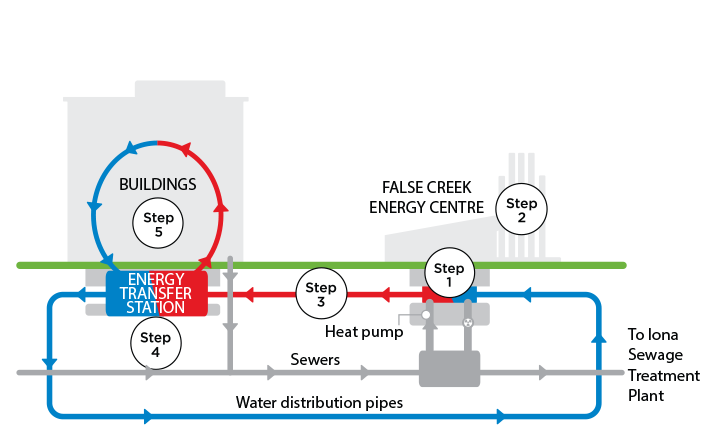
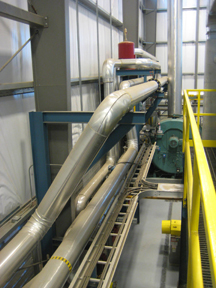
Most district energy systems generate heat at a central plant, or extract heat from other sources. The heat is transferred to a fluid and distributed via underground pipes to buildings where it is used for space and water heating. The fluid is then returned to the source to be reheated and recirculated. Some systems also provide space cooling in a similar way. They may deliver energy services with greater efficiencies and lower emissions than individual furnaces, boilers, electric baseboards, and water heaters fueled by oil, natural gas, propane, or electricity.
Examples:
- Sapperton Renewable District Energy System (City of New Westminster)
- Burnaby Mountain District Energy Utility (Corix, SFU UniverCity)
- False Creek Neighbourhood Energy Utility (City of Vancouver)
- City Centre / Oval Village District Energy (City of Richmond)
Complementary measures
- Land use planning that encourages compact, complete communities.
- A Community Energy Plan to develop strategies for energy infrastructure within a broader energy and emissions plan. The CEA created a Community Energy and Emissions Planning guide which describes the purpose and content of a community energy and emissions plan, its benefits, and how to go about creating one.
- Resource Management Plans and wastewater energy recovery, encourage energy inputs from several sources (such as refrigeration-heat from an ice-rink, sewer heat, biomass, etc.) providing more opportunities for carbon-neutral energy.
What district energy can do
District energy systems have the potential to reduce the size of heating and cooling infrastructure, reduce emissions, and even reduce costs.
- District energy can take advantage of load diversification (the different daily energy demand patterns of residential, commercial, industrial and other uses) reducing the size of the infrastructure needed to service them. With a range of users and sharing of heating and cooling flows, overall peak demand is flattened. In the North Vancouver (City), the Lonsdale Energy Corporation system is operated with a fraction of the boiler capacity that would have been needed if each building was equipped with its own conventional boiler system.
- District energy systems can be cost effective due to economies of scale, longer amortization of equipment and lower financing costs.
- District energy can enable the use of major local alternate/renewable energy sources. For example, they can incorporate geoexchange or sewer heat recovery. Because of the cost effective aspects described above, this can make the development of more capital intensive renewable energy sources more feasible. These sources can potentially reduce emissions significantly due to heating and cooling.
For a neighbourhood, development or connected building, large-scale implementation of renewable sources via district energy systems has the potential to displace most or virtually all of the demand for conventional heating energy sources such as gas. Even district systems that use gas for peak heating needs can reduce emissions significantly.
New vs. existing developments
District energy systems probably have the greatest potential in reducing the emissions from new developments, as the cost of building district infrastructure is generally lower for new construction compared to retrofitting, and buildings can be designed for compatibility. Vancouver’s Southeast False Creek sustainable community project is an example of this.
However, there is also potential for new or even existing local government buildings and facilities to connect with a district system. For example, swimming pools and arenas are energy intensive and can complement each other, and/or improve the load diversity of a district system that includes other energy uses such as residential and commercial buildings. Revelstoke’s biomass district heat system provides low pressure steam to energize the dry kilns for a sawmill (the source of the wood residue biomass) and provide hot water through an in-ground piping system to several buildings in downtown Revelstoke.
System Economics
The economics of district energy are very site-specific. As a rough rule of thumb, a neighbourhood will be a good candidate if it has some of the following characteristics:
- Several large buildings or building complexes (such as hospitals, hotels or colleges)
- A mix of uses (such as a town or village centre)
- Moderate and higher residential densities (such as multi-family units or apartments)
- Relatively small spacing between buildings and a grid street layout
- A source of relatively cheap energy (such as waste heat from an existing boiler or sewage treatment facility)
- Few electric resistance heating systems in existing buildings (these cannot be easily retrofitted)
Management
A Neighbourhood Energy Utility (NEU) is the institutional structure that underpins a district system if it crosses property boundaries. An NEU may be owned and operated by different parties, including developers, private utilities, and/or local governments. Historically, most local governments are not in the energy utility business; however, as district energy/NEU’s offer a potential revenue stream, many local governments are either looking at expanding their existing systems, or initiating new ones.
Often, an NEU evolves via business discussions with private energy utilities and developers. These discussions may also involve local governments where there is interest to pursue it.
Learn more:
- The Community Energy Association’s Utilities & Financing includes more detailed information on local government ownership and operation of heating utilities.
- Regulation of District Energy Systems examines the services, financials, governance, and rate-setting frameworks for nine diverse systems in British Columbia. The report outlines risks associated with system development and provides recommendations on how policy makers and regulators can reduce these risks, while ensuring that systems reduce emissions, improve efficiencies, and deliver reasonably priced energy services.